(Sunday 1st November, 2026)
Over to Parkgate on the Wirral Peninsula this morning where there was a blanket of fog stretching across the marsh. It was a windless 7°C when we arrived and the temperature didn’t climb much higher all morning, which meant that the fog lingered. But visibility was still reasonably good and we were able to witness a fair bit of activity around us.
We’d parked up at the Old Baths where there were three female pheasants huddled together on top of the wall! Below them on the marsh itself were several more pheasants, mostly male from what we could see. The pheasant, or more accurately, the Ring-necked pheasant (Phasianus colchicus) is classified as a game bird and can be shot during the pheasant-hunting season, which runs from October to February. But the marsh at Parkgate is owned and managed by the RSPB and shooting or wildfowling is strictly prohibited on any land owned by the society. So, whether by luck or smartness, these birds were safe if they stayed on the marsh – well, safe from humans at least.
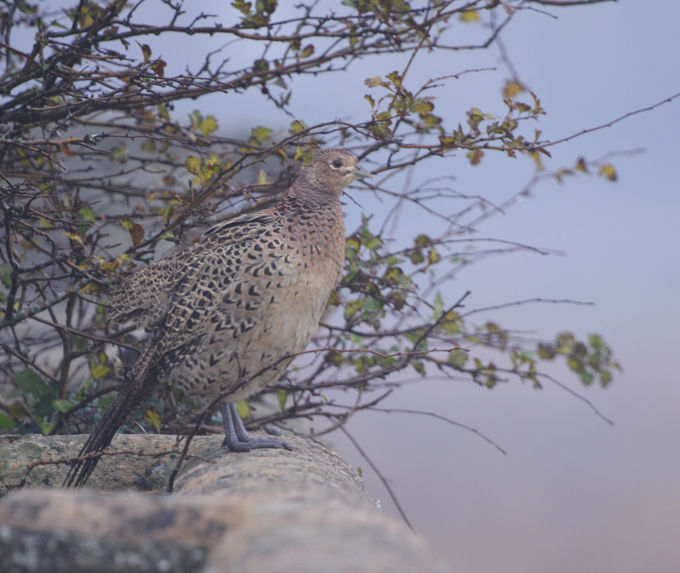
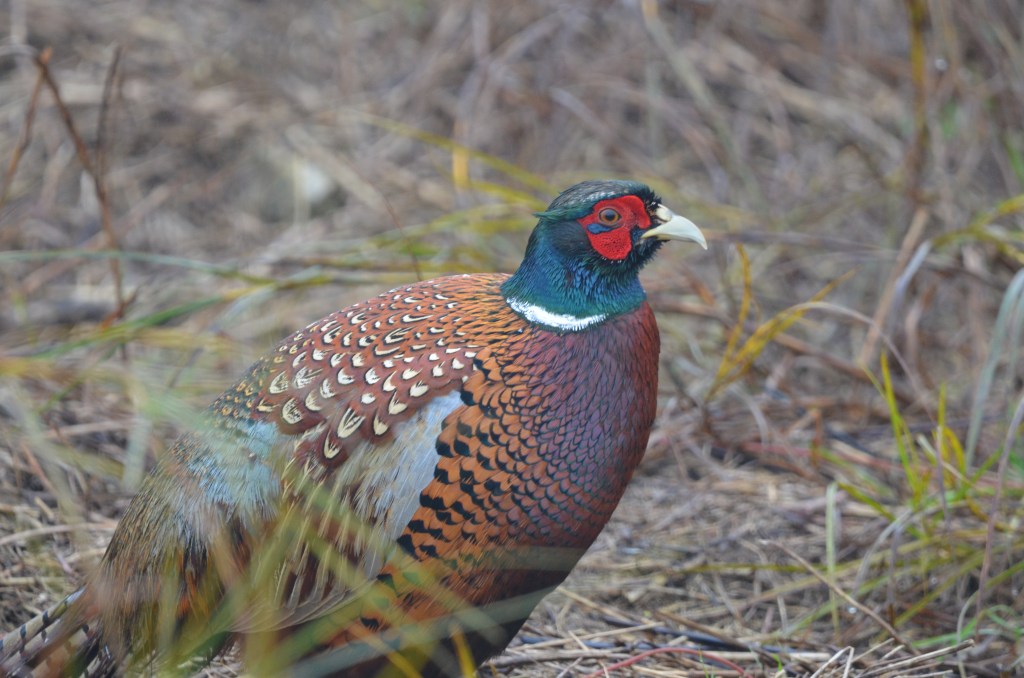
Top: the female Pheasants preferred the wall; whereas bottom: the males were happier on the marsh
A Black-headed gull (Chroicocephalus ridibundus) was perched on the wall, unperturbed by our presence. The gull’s black head (actually chocolate brown rather than black) is its breeding plumage so today it was in its winter’s clothes, so to speak, which means a white head with a dark smudge behind each eye, although the Black-headed gull retains its red legs and dark red bill throughout the year.
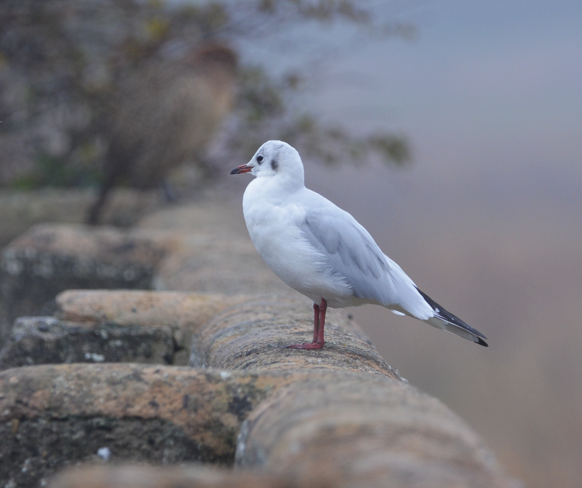
Black-headed gull in winter plumage
Further out on the marsh we made out a few ducks on the flash and also a statue-like Grey heron (Ardea cinerea). We heard geese honking as they flew by, but they were just unidentifiable dark smudges in the fog.
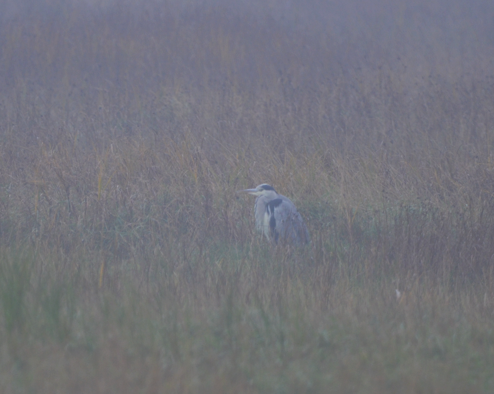
Grey heron
Closer by, though, we heard a small group of birds excitedly twittering. These were Redwings (Turdus iliacus) which are the UK’s smallest thrush and they were all feeding ravenously on hawberries. Redwings migrate from Iceland and Scandinavia and over-winter here before returning to their homelands in the spring. The back and wings are dark brown and the pale underside is streaked with dark brown. The Redwing has a distinctive creamy-white eyestripe, and the reddish-orange splash of colour that gives the bird its name is actually on its flanks beneath its wings. A lovely bird.
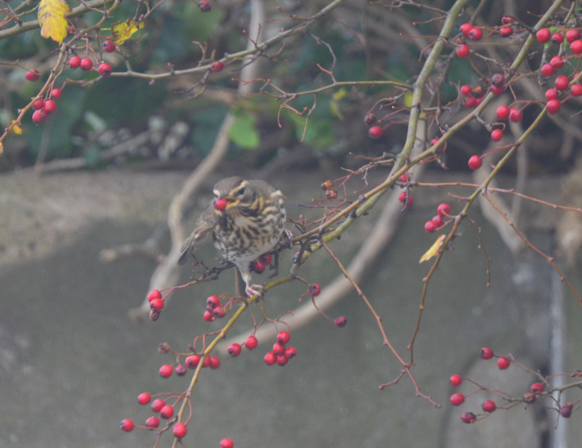
Redwing munching a hawberry
No sooner had the Redwings taken off in search of more berries than a small flock – or ‘charm’ I should say – of Goldfinches (Carduelis carduelis) arrived to take their turn. It was uncanny. We watched as they flitted boisterously from tree to tree before launching themselves across the marsh to land on what we think might have been teasels. Entertaining to watch, these Goldfinches!
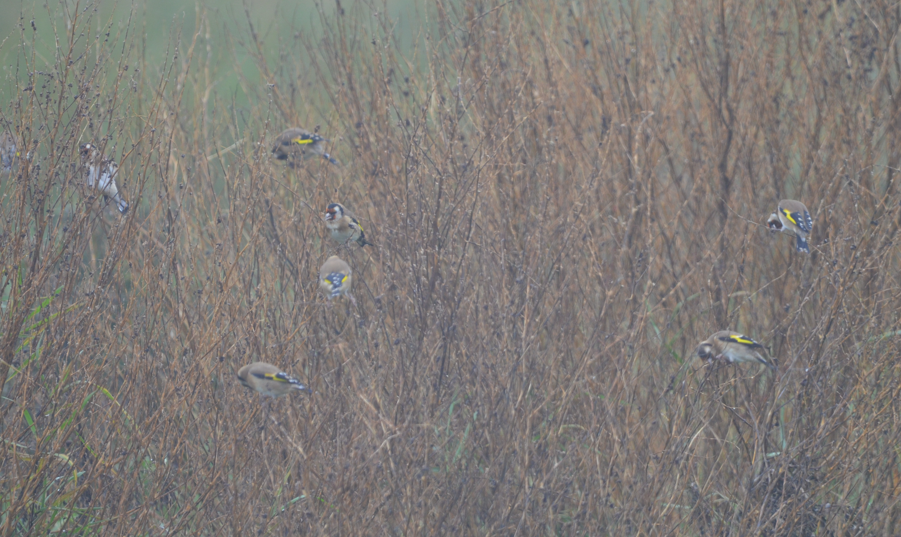
A charm of Goldfinches
While the Redwings and Goldfinches were feasting, a Marsh harrier (Circus aeruginosus) flew low over a section of the marsh but quickly disappeared into the mist before we could get a decent view. Judging by its size, though, this was the larger female.
A couple of Stonechats (Saxicola torquata) put in an appearance too. The male is identifiable by its black head and white collar, whereas the second bird with its brown head and duller underparts could be either a female or immature Stonechat.
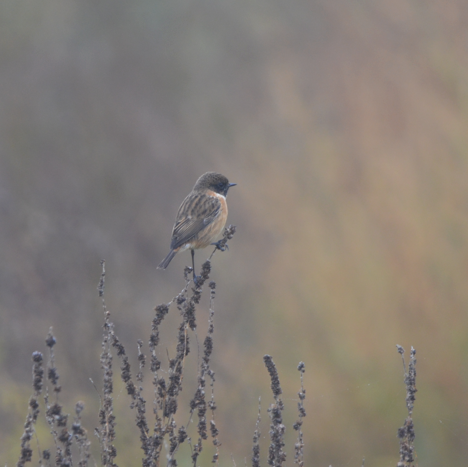
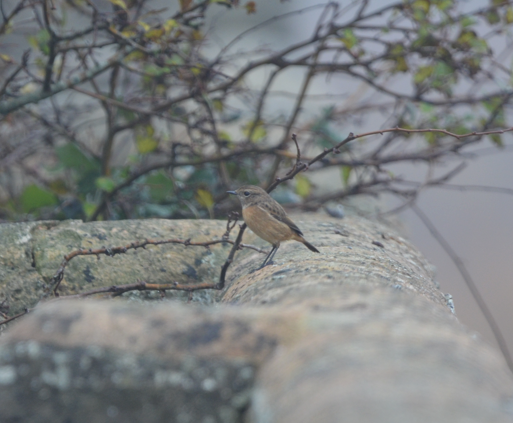
Top: male Stonechat; bottom: female or immature Stonechat
Shortly after we’d first arrived, we’d heard the distinctive bubbling call of a Curlew (Numenius arquata). It had sounded as if the bird was nearby but we were unable to locate it. As we were about to go, we caught a glimpse of it flying across in front of us: although the bird was mostly silhouetted in fog, there was no mistaking the characteristic shape – particularly the long curve of the beak. We didn’t get a photograph but it’s enough to know that these endangered birds are still showing up on and around the Dee Estuary.
Stu sent up his drone again and took some aerial photographs of the marsh at Parkgate. Hopefully, these should give you an idea of the marsh and its surroundings, especially for those of you who are unfamiliar with the area. You can see why such a vast number of birds and wildlife are attracted to the reserve – remember, this is only in a small part of it! And also you can get an idea of this morning’s conditions and how general visibility was affected.
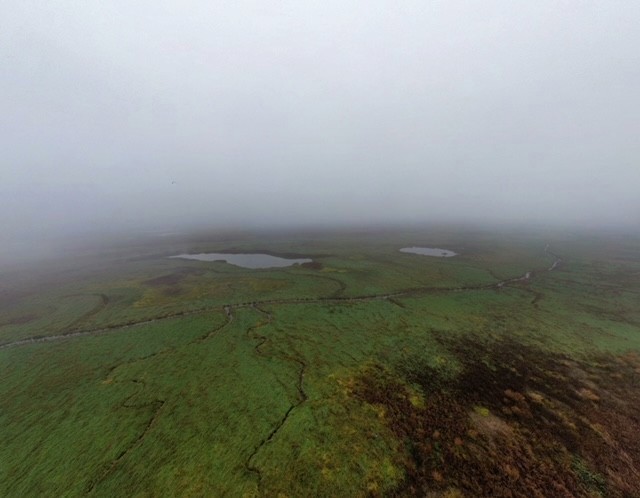
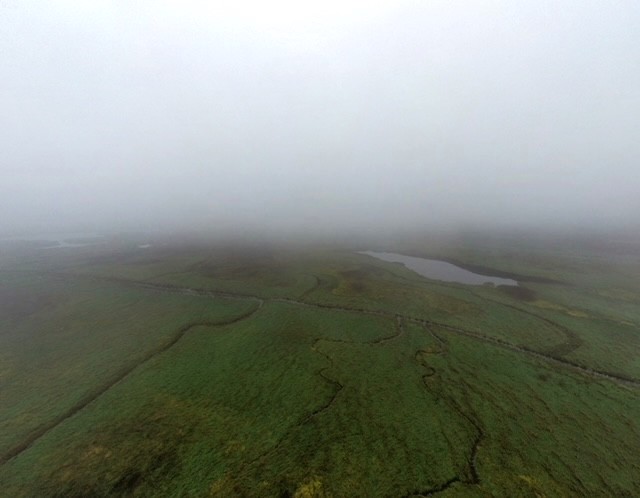

Photographs from above the Old Baths, Parkgate: although it’s foggy, you can see just how wide an expanse the marsh covers – and this is just a section of it. The bottom picture is a panoramic view of where we were.
The important stuff
We went to the café at Daleside Garden Centre in Hawarden on our return and had a slice of White Chocolate Eton Mess each with our customary cappuccinos. Delightful!

Leave a Reply