(Sunday 15th November, 2026)
Over to RSPB Burton Mere Wetlands on the Wirral Peninsula this morning. The temperature didn’t climb higher than 6°C while we were there and it felt a lot colder due to the easterly breeze. The reserve was certainly quiet, though whether this was because the birds were having a duvet day or because we’d arrived at low tide and many of the birds might have been feeding further out on the estuary, it was difficult to say. Probably a bit of both.
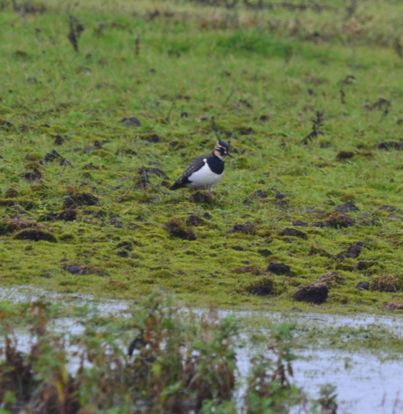
Lapwing
There were of course some birds at the reserve, though the mist and cold seemed to have drained their desire to make much sound. We saw lots of Lapwings (Vanellus vanellus) out on the flash by the visitor centre and as we were passing the café, we were lucky enough to see a Goldcrest (Regulus regulus) foraging for insects in the bark crevices of a nearby tree. The Goldcrest is the UK’s smallest bird – in fact, it’s the smallest European bird, weighing in at just 5 grammes. This one is facing away in the photograph, so its yellow crown stripe isn’t visible, unfortunately. We watched it for a few minutes until it flew higher up into the tree canopy and eventually out of sight.
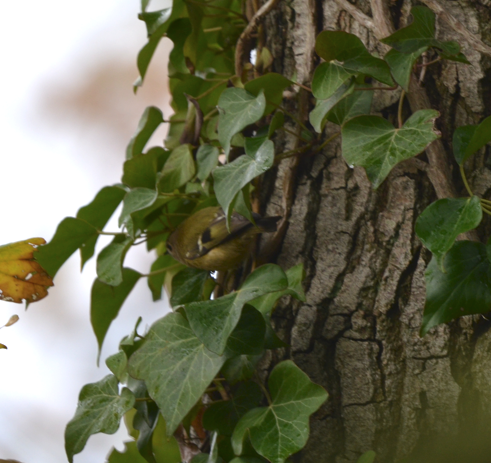
Goldcrest
We saw several Black-headed gulls (Chroicocephalus ridibundus) and Mallards (Anas platyrhynchos) as we passed the mere. The gulls looked like they were taking to the air, circling once or twice, and then landing back on the water, possibly in an attempt to keep warm.
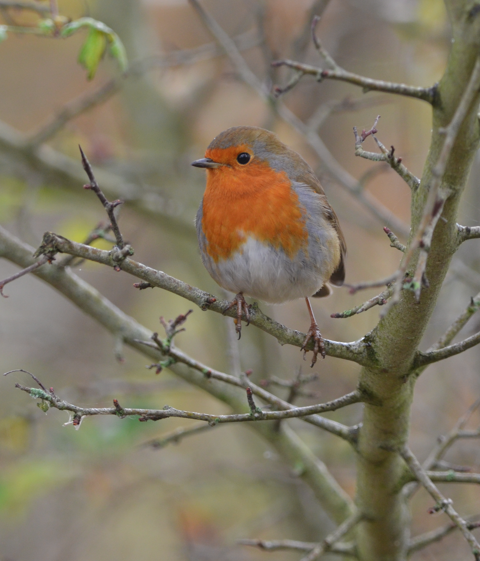
The Robin is one bird you can rely on, whatever the weather!
A small crowd huddled at the reed bed screen hoping for a glimpse of the Bittern (Botaurus stellaris) that’s been spotted here recently. As neither of us has ever seen a Bittern before, we did consider joining everyone but decided against it. The same group was still there on our way back so we were glad we decided to pass on this occasion. It really wasn’t a day to spend too long standing in the cold!
We carried on to the Marsh Covert hide, although the only birds we could see were right across on the farthest pool, so we trundled over to get a closer view.
A mixed flock of Shovelers (Spatula clypeata) and Teals (Anas crecca) were resting at the edge of this pool – known as the Border Pool. Most of the birds had their heads tucked behind them. The Shovelers, as their name suggests, have large bills for ‘shovelling up’ food from the water but these bills are longer than their heads and such an extensive surface area sometimes needs help in keeping warm. So the ducks twist back their heads and rest their bills in their feathers, and this allows them to relax their neck muscles too.
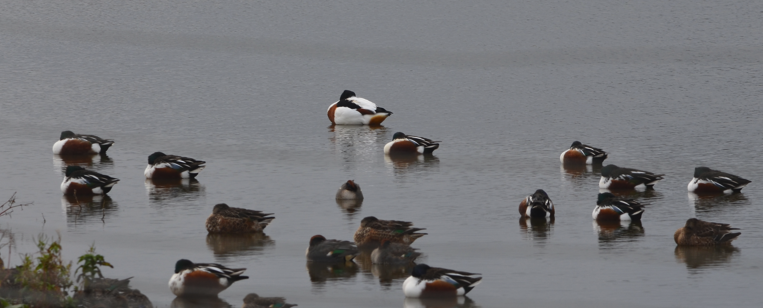
Shovelers, Teals, and one Shelduck
The Teals, which are the UK’s smallest duck species were resting their heads in the same way. These ducks are in the bottom centre of the photograph: you can see the pale yellow tail patch and make out the green wing patch on a couple of the birds. Both Teals and Shovelers are dabbling ducks, getting their food from the surface of the water or just below it, and both species tend to group together during the non-breeding season as the increase in numbers means better protection from predators. Incidentally, there’s also a single Shelduck (Tadorna tadorna) in the photograph (centre top).
A pair of Pintails (Anas acuta) swam magisterially across the pool. The male Pintail has long, black tail feathers (hence the name) and a grey body, and the white colouring of its neck extends into a thin line around the back of its otherwise brown head. The female’s plumage is mottled brown and more subdued than the male’s. Pintails have long, slender necks, which give them an air of elegance that you seldom find in other dabbling ducks. Very striking.
We also saw a couple of Wigeons (Mareca penelope). The male Wigeon has a light brown head with a creamy yellow stripe down the centre, and its bill is bluish grey and tipped with black. It has a pinkish breast and white underbelly, with grey back and wings. The female is mottled brown and similar to a female Mallard, though Wigeons are smaller in size.
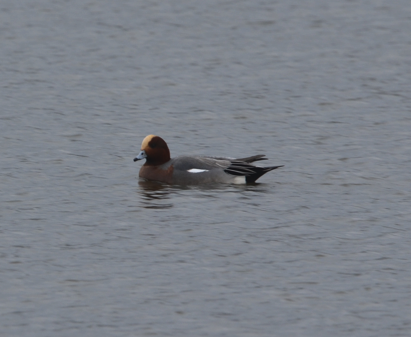
Wigeon
The important stuff
At the café, we supplemented our regular cappuccinos with a slice of Honeycomb Tiffin (Stu) and a Toasted Teacake (Col). Very welcome!
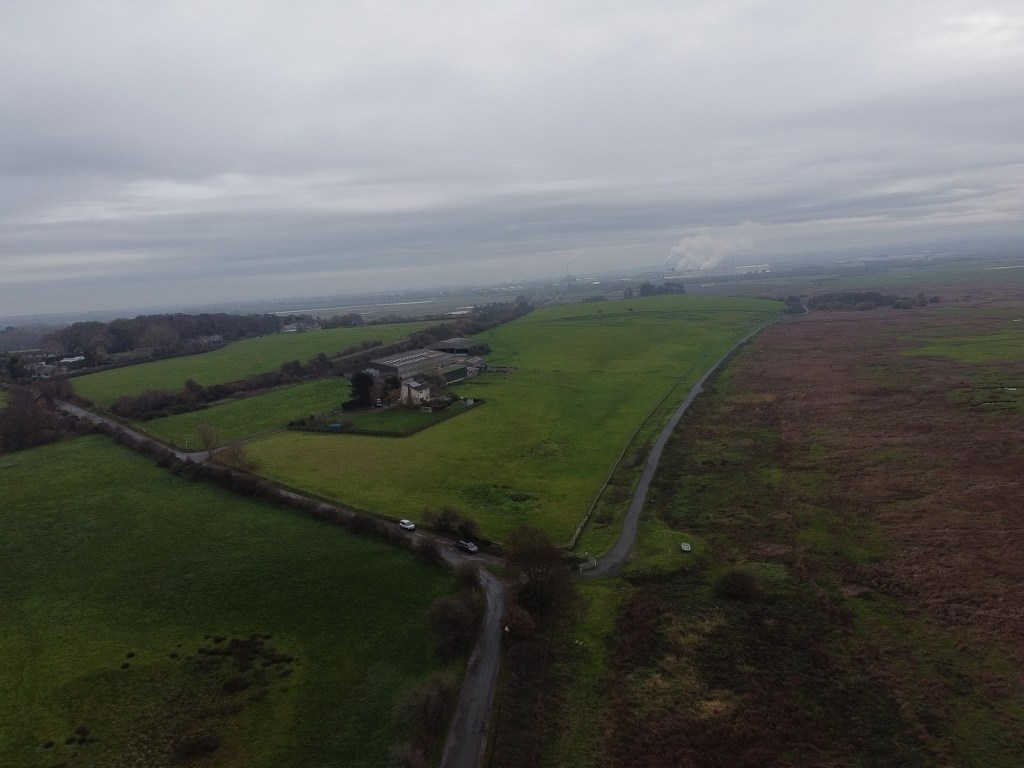
We took a detour down Station Road to Burton Marsh before we set off home, so that Stu could get some aerial photographs with the drone. You can see just how much of the River Dee’s inner estuary is covered by saltmarsh.
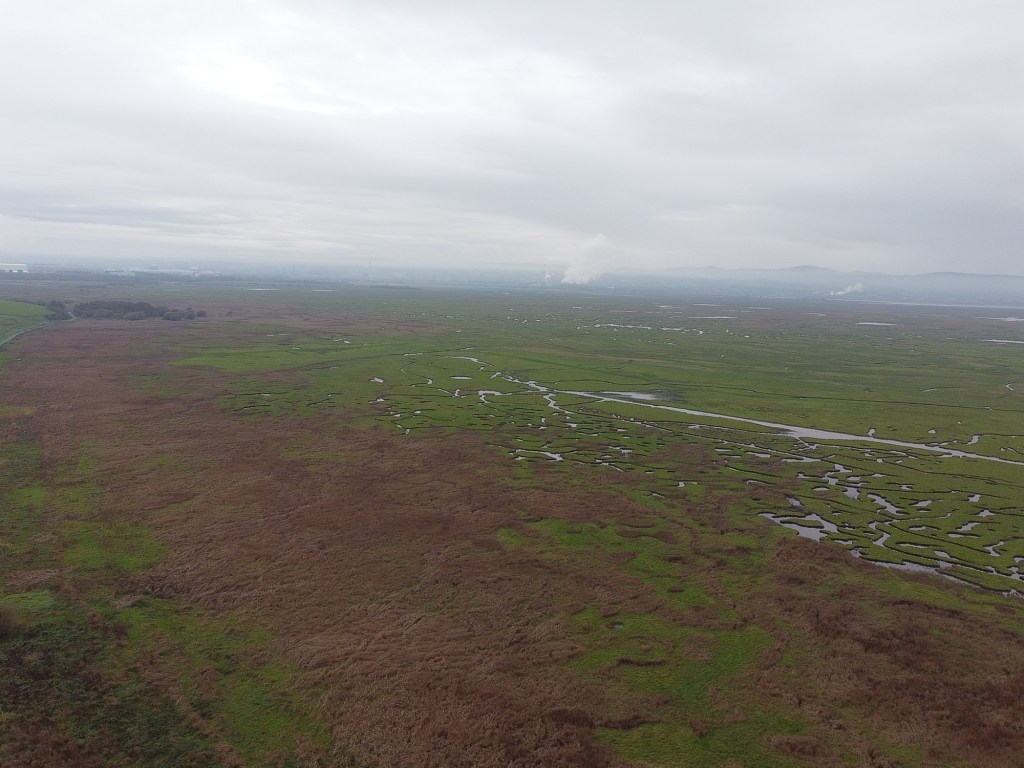
On the left you can just make out the inverted catapult that is otherwise known as Flintshire Bridge. To the centre-right of the picture, the white vapour you can see is steam from the cooling towers at Connah’s Quay Power Station.
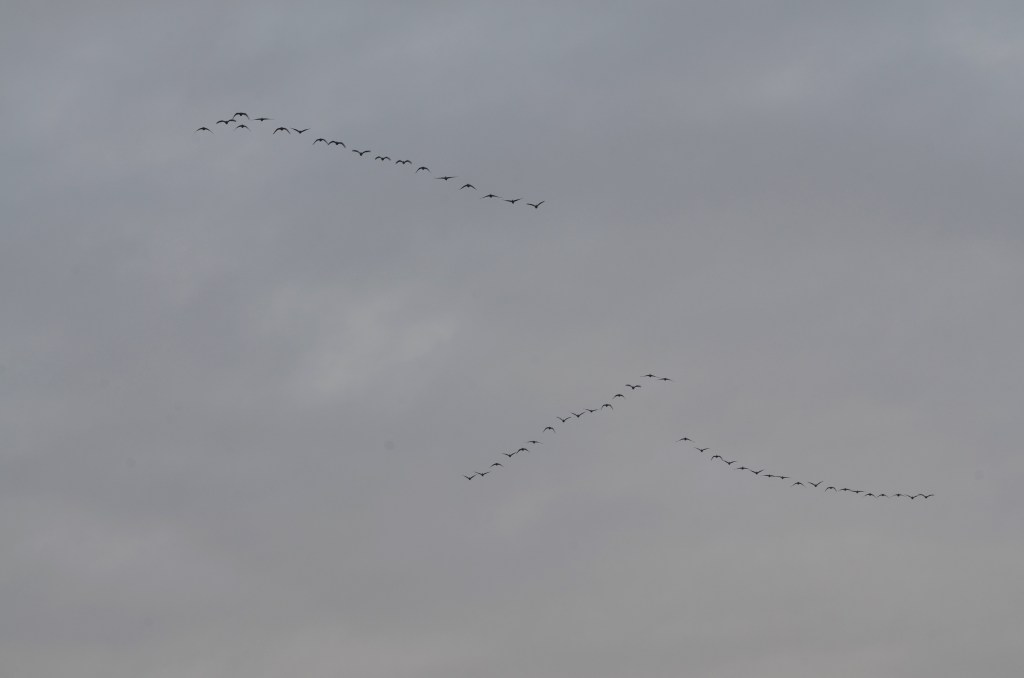
Above: Geese in the skies above the marsh; below: looking towards RSPB Burton Mere Wetlands from Station Road

Leave a Reply