(Thursday 21st August, 2025)
Over to the RSPB wetlands at Burton on the Wirral peninsula today with my mother, my youngest brother, Michael, and his eldest daughter, Sophie. None of them had visited here before. The sun came out from time to time, but it was otherwise overcast. When we arrived, we were told that a Bittern had been seen at the reedbed: it showed itself twice during the time that we were there, but not in our presence I’m afraid!
A Greenfinch and a Great tit were taking it in turns to visit the feeder, just beyond the visitor centre. While absorbed in this sight, we noticed movement in the undergrowth, and after a few moments we saw several rats shuffling along stealthily: they looked very well-fed and were obviously regular visitors to the ground beneath the feeder, capitalising on all that the birds habitually spilled.
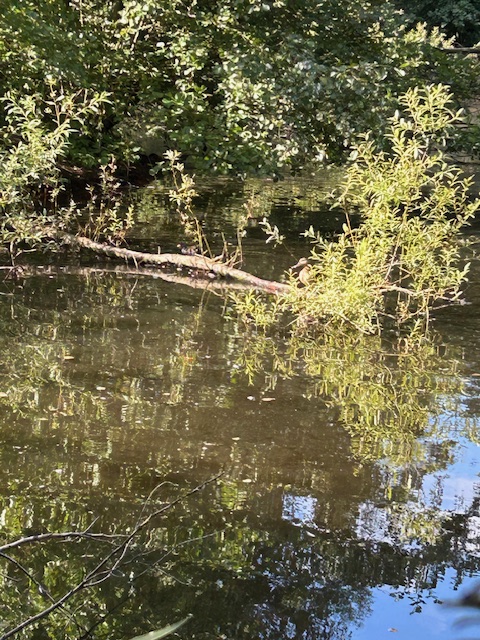
Above: Mallard on tree trunk (Photo: Sophie)
We meandered around the mere, noting a Mallard squatting on the upper part of a tree-trunk that was half-in, half-out of the water, and a pair of Moorhens that were investigating the edge of the shore for food. While we were looking over at some Canada geese that were swimming at the northern part of the mere, there was a commotion in the water nearby: a Cormorant surfaced, took a few breaths, and then dived in search of fish again. A chance now-you-see-me-now-you-don’t sighting which we were all happy to have witnessed.
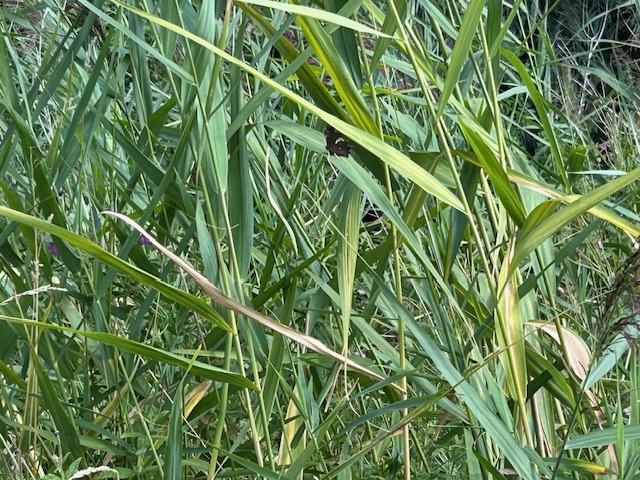
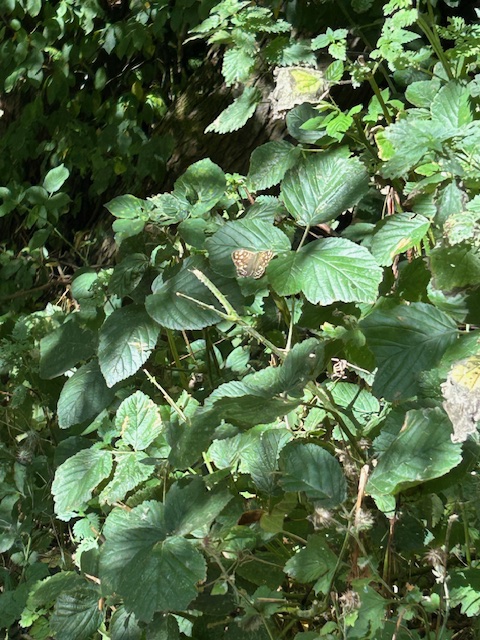
Left: Comma – note the distinct white mark that gives the butterfly its name, and Right: Speckled wood (Photos: Sophie)
There were plenty of butterflies today, including Small whites, Green-veined whites, and lots and lots of Speckled woods. In fact, as my niece, Sophie, was focussing her camera-phone on one Speckled wood that was stretching out its wings atop a leaf, a pair of them were spinning around each other as they passed. Sophie also managed to photograph a Comma, its wings upright, and another butterfly which we suspect is a Dark-green fritillary, though we can’t be sure. This is guesswork really, as camera-phones are limited in the photographic detail that they capture, so the resultant picture isn’t exactly pristine. However, given the area that we were in – ancient oaks predominantly – and the fact that the commonest fritillary in the United Kingdom is the Dark-green, we’ll plump for that. (Please let us know if you have other thoughts).
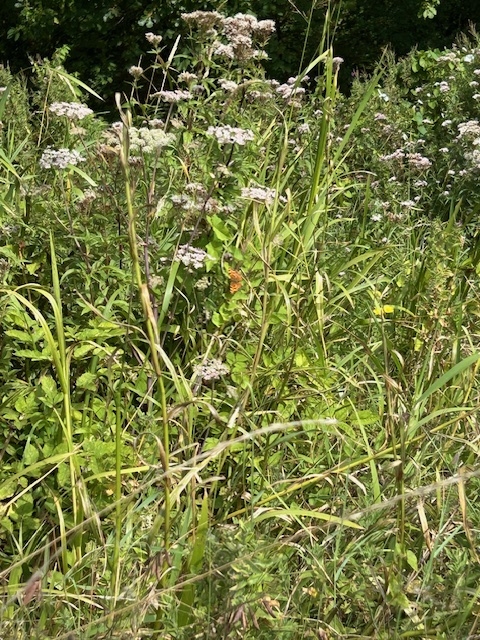
Above: Dark green fritillary? (Photo: Sophie)
Regular readers will remember that on Sunday just gone (17th August), we reported lots of small flocks of Canada geese orbiting the marshes nearby. Judging by the amount of Canada geese at the wetlands today, they had all ended up here! They were by far the most numerous bird species to be seen from the main Reception area and also from the Bunker hide, and now looking from the Marsh Covert hide, it seemed that all we could see was Canada geese. However, as if to dispel this idea, Sophie suddenly drew our attention to a Common buzzard that she’d spotted circling to the south, and which rapidly rose in the air on the thermals. We all watched it through the windows, noting its large size even at a distance.
A number of orange-red dragonflies shadowed us along the paths between the Marsh Covert and Border hides and seemed, at times, to be leading us onwards. These are Common darters, and we even saw one pair mating while they were in flight. A Marsh harrier crossed close overhead and, while we didn’t manage to photograph it, we did have a clear view of its underwing, which was the distinctive grey, fringed with black outer feathers, of the male.
From the Border hide we could see lots of Greylag geese, Lapwings, and Black-tailed godwits, and we also observed a couple of Redshanks on the far bank and some Teal on the isle nearby, just visible amongst another group of Greylags. On the return journey, just as we emerged from the small copse, a Kestrel flew across our path.
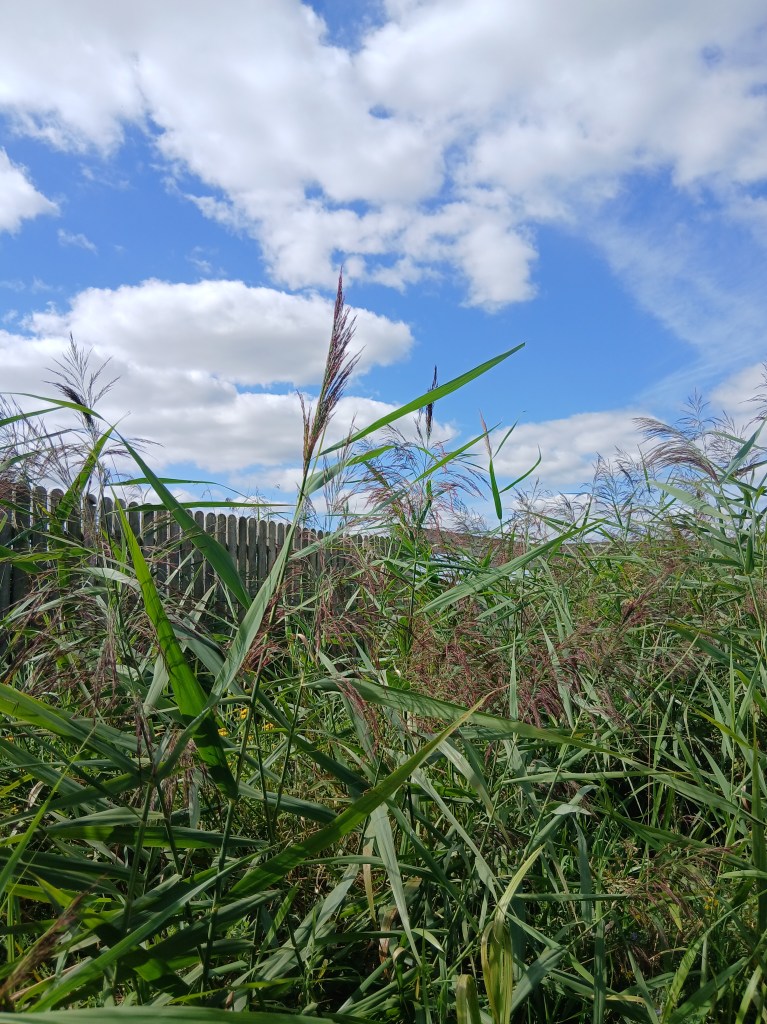
Above: Common reed
Sophie and I detoured to the reedbed to see if the Bittern was there, but sadly not. As I mentioned at the very beginning of this article, the Bittern was only eluding us – it seems that everybody else saw it that day! A lucky few also saw a Kingfisher and a Hobby. Maybe another time, but I do know that Michael, Sophie and my mother were thrilled to have seen so much during their visit. As we emerged from the reedbed viewing spot, my mother, who was waiting with Michael, said: ‘Did you see the big bird, then?’ I thought we’d missed a Heron or an Egret or another large bird, but she meant the Airbus Beluga which had just flown past. Very amusing!
The important stuff
All four of us had cappuccinos, accompanied by Blueberry muffins (Sophie, Michael, and my mother) and a very tasty vegetarian pastie (Col). Awesome!

Leave a comment