(Monday 16th June, 2025)
A couple of female Blackbirds put in separate appearances while I was in the garden today: presumably they were gathering food for their respective broods. My eyes were drawn to a snail shell at the base of some past-flowering cowslips. It was bright yellow with dark brown – almost black – concentric bands. I looked it up later and this is the Brown-lipped snail (also known as the Brown-lipped banded snail). The name refers to the band of colour around the shell’s opening.
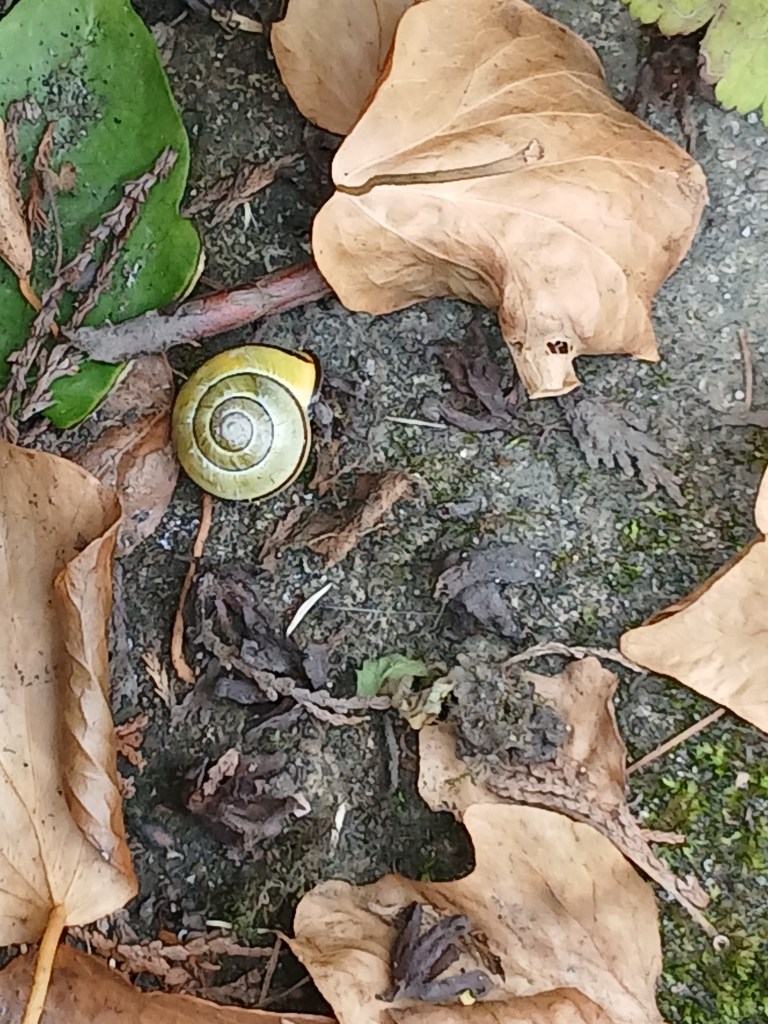
The shell colour can vary from light yellow to dark brown, although oranges and pinks can occur (I’m beginning to sound like a Weather Forecaster, covering all eventualities!), and there can be from none to five bands (or stripes). You won’t be surprised to learn that the reasons for the variations in shell colour and banding are not known, though it is suspected that camouflage might play a part.
The Brown-lipped snail is common throughout most of the United Kingdom and can be seen in various habitats, including woodland, hedgerows, and gardens, so the variations may be adaptations to their surroundings, although nobody can say for sure.
Behind me, I heard a lovely tinkling sound. I looked up and, sure enough, there was the usual Goldfinch singing from his perch at the end of next door’s television aerial. This particular Goldfinch has been taking a turn for a few days now: one day he continued to sing while a Jackdaw perched on the chimney pot a little lower. In fact, the Jackdaw flew off, leaving behind the Goldfinch!
I left this colourful chorister singing and turned back to the garden. Another Goldfinch sang from the top branches of the willow in my neighbour’s garden and then flew across mine, landing over the far side of the hedge, where it resumed its song. No wonder they’re called a ‘charm’ of Goldfinches!
