Tag: wildlife

  • Fresh after the heatwave

    (Sunday 22nd June, 2025)

        Over to Burton Marsh this morning with Stu. We’ve just had temperatures above 25° C for three consecutive days both sides of the Dee estuary – i.e. North-east Wales and West Wirral). Although the sunshine was welcome, the heat was sultry. This morning there was a stiff WSW wind blowing, and the odd drop of rain, which together had driven away the sun. Unsurprisingly, not many of the birds was willing to come out and play – the change in the conditions felt more like spite than respite!

        We did see a Little egret shadowed by its partner. Both birds disembarked in a long channel of water some distance out, which was mostly occluded by marshland. Even through binoculars, we were unable to see any other activity. The egrets didn’t stay long and soon returned north-eastwards towards Neston.

        There were some Blackbirds, a Robin, and the usual indefatigable Crows. (I caught a glimpse of what I thought might have been a Cetti’s warbler, but it was too brief a glimpse for me to be certain – I shall look out next time).

    Despite the absence of the birds, there was still plenty to see.

    ""

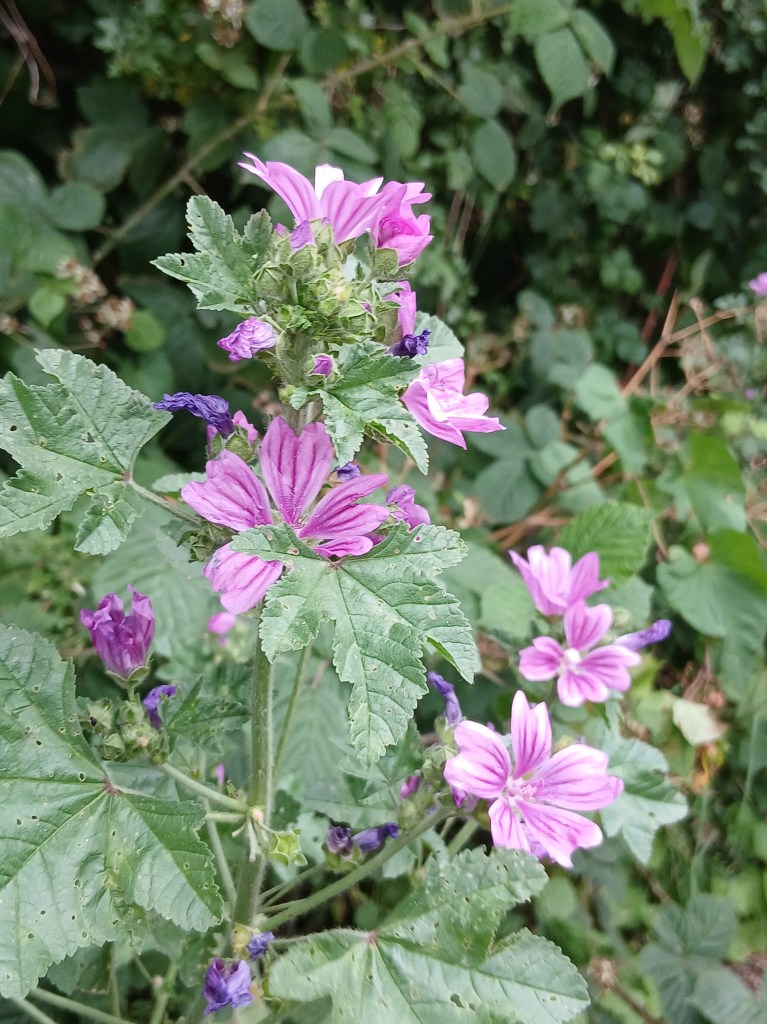
    Meadowsweet abounded and we did the obvious and held the creamy yellow flowers to our noses – oh, what a lovely smell, as the name says really. The Common mallow is a quite lovely plant too, I think, with its tall stem and large flower-heads. The five grooved petals are lilac-pink with dark stripes.

    There was Tufted vetch, splashes of Dandelion, and Field bindweed. I had to look up the latter when I got home. Although the flower shape is obvious on reflection, it was the pale pink and white colours of the petals that threw me. One flower that I did recognise was the Yellow iris, which are also known as Yellow flag (but not by me). These flowers were all a little further out on the marsh and I suppose that they are an indicator of where the water channels and pools lie.

    The important stuff

        After all this hard work, Stu and I retired to Nets Café to sample the cakes on offer: I had a lovely slice of Bara Brith to go with my cappuccino, while Stu had Coffee and walnut cake with his. Very pleasant.

  • An Avian Array at RSPB Burton

    (Sunday 25th May, 2025)

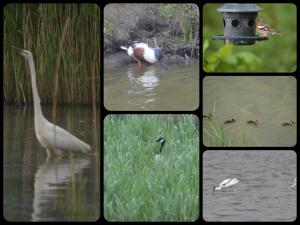
        Stu and I went across to Burton Mere Wetlands, the RSPB’s nature reserve on the Wirral. It was very windy as we got out the car, so it was good to get inside the relative calm of the visitor centre. Initially, it was just us and the staff, but that soon changed as people began to arrive. I tried to list what we saw – we were pointing out different species to each other like excited children – although one or two observations may be wrong. (I’ve indicated where we were uncertain). There was certainly plenty for us to see!

        There were lots of Avocets, many of which had paired, and some of which were schooling their young – although it looked like the chicks were managing the distinctive ‘scooping’ action in the shallows without any instruction. There were a couple of Oystercatchers and, looking closer, we realised that these also had chicks, which they were keeping close by. As I was watching the Oystercatchers, I caught a glimpse of a couple of ducks leading their brood of six ducklings against the current to a quiet spot where there was just a lone Black-headed gull and a foraging Moorhen.

    Avian array

    At first, I thought that the ducks were Mallards but something didn’t quite add up. I looked again and saw that the male had a cinnamon underbelly, unlike the Mallard drake, and that his bill was distinctly wider: thus did I spot my first Northern shoveller (with help from my bird identification book!)

        There were four Shelducks, a Crow and a Magpie amongst a host of Black-headed gulls. So far, so good. However, I then saw what I at first thought were Goldeneyes, a species I had never encountered outside of a book. My reasoning was simple: they had yellow eyes. It was only later that I found out that the UK also hosts other yellow-eyed ducks including Tufted ducks and Scaups. (I discounted the Northern shoveller due to its plumage differing, although this too has yellow eyes). Unfortunately, the only thing I can be sure of is that my original assessment that they were Goldeneyes was wrong: I thought Scaups because I couldn’t see any tufts, but I believe these are rarer than Tufted ducks in our UK waters. It shall remain a mystery.

        We exited the visitor centre and travelled around to the hide a little bit further west. On the way we took in marsh marigolds, red campion, buttercups, pyramid orchids, hogweed and teasel. There were a couple of male Chaffinches arguing over some seeds in one of the feeders, and we were lucky enough to see an almost motionless Little egret move from its reedy hideout in one of the ponds. Stu took some photographs of a Canada goose – or, rather, the slender neck and head of a Canada goose as it peered above its section of reeds too. We looked in vain for the Marsh harrier that can often be seen from this hide: perhaps next time.

        We then moved to the farthest hide where we saw a Lapwing duo and about a dozen or so Black-tailed godwits probing the shallow waters with their long orange and black bills. These godwits were all displaying pale orange to brick-red plumage, which I am informed is its ‘breeding plumage’, although there is no evidence of chicks just yet*.

    The important stuff

        We then went to the café for our customary cappuccinos, which we thought prudent to accompany with lemon (Stu) and blueberry (me) muffins, which rounded off a lovely morning!

    *Apparently, very few Black-tailed godwits actually breed in the UK, although no-breeding numbers are increasing rapidly as a result of agricultural changes in Iceland, where most of the UK birds come from (Black-tailed Godwit | BTO)