(Sunday, 7th June 2026)
Over to Loggerheads Country Park in Denbighshire today. The wind (SSW) was quite blowy on occasion but you barely noticed it here as the woods are so sheltered. Although overcast the morning remained dry and the temperature didn’t rise above 15°C.
The ditch between the car park and the buildings had been drained and cleaned up, prior to relining it. While we were examining this work, we noticed a Grey heron standing motionless in the pond just beyond the sluice gate. We carried on down the path for a better view and stood watching as the bird stealthily stalked the pond in search of prey, although it loos like its collecting nest material in the photograph below.
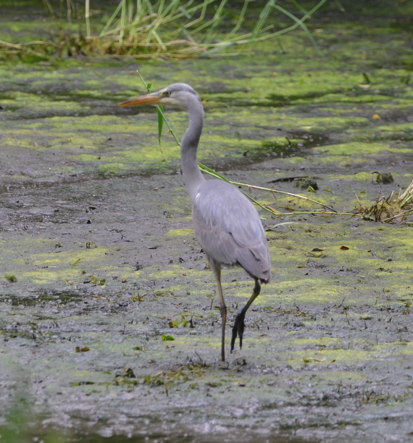
Grey heron with leaves in its beak
As we came to the stone bridge that crosses the River Alyn to join the Leete path, we saw a plant with bright, white, four-petalled flowers. This is Dame’s rocket which more commonly flowers as a purple or lilac colour. The white petals on this version seemed to hold their own light and certainly stood out against the predominantly green foliage in the background.
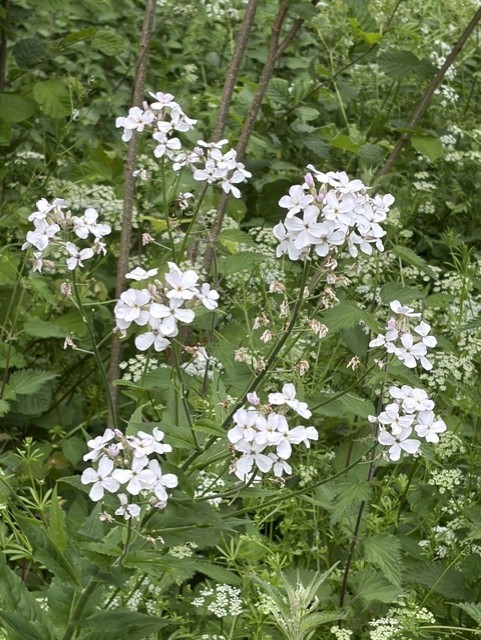
Dame’s rocket
Surprisingly, the wild garlic flowers that had carpeted the woods only weeks before had all but gone, with just the occasional earthy whiff reaching us. A reminder of how quickly time marches on, I suppose.
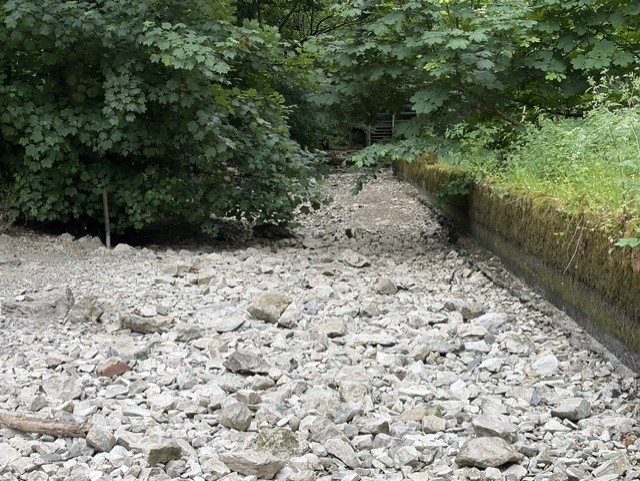
The River Alyn’s waters often disappear underground, leaving the bed dry
A short way along the river we were reassured to see the White-throated dipper once again: we hadn’t seen any Dippers since they had (presumably) abandoned their nest further downstream after the Alyn’s water had receded, a not uncommon occurrence here at Loggerheads which we’ve covered elsewhere on the blog.[1] Good to see, although it was just the one Dipper that made a fleeting appearance this morning.
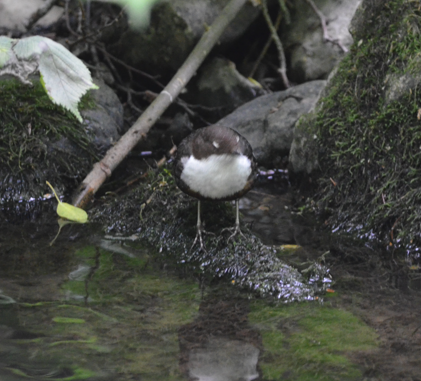
White-throated dipper photographed mid-blink
Nature doesn’t always provide us with pleasantness, it has to be said, and shortly after our Dipper had disappeared upstream, there was a raucous commotion in the trees on the opposite bank. We looked over to see a Eurasian jay with a small bird in its beak, while another small bird had the Jay’s tail in its beak.
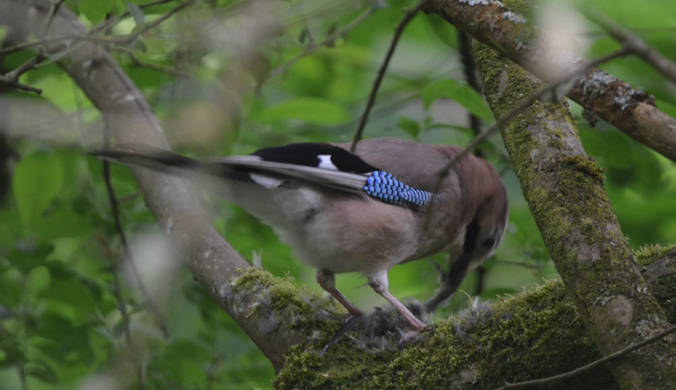
Eurasian jay devouring prey
The two smaller birds were Great tits and, though it was difficult to be absolutely sure, it looked like the Jay had taken an adult Great tit and that this poor bird’s mate was valiantly trying to rescue it. The second bird flew off as the Jay turned on it, tentatively returning a little while later, by which time the Jay had finished off its partner.
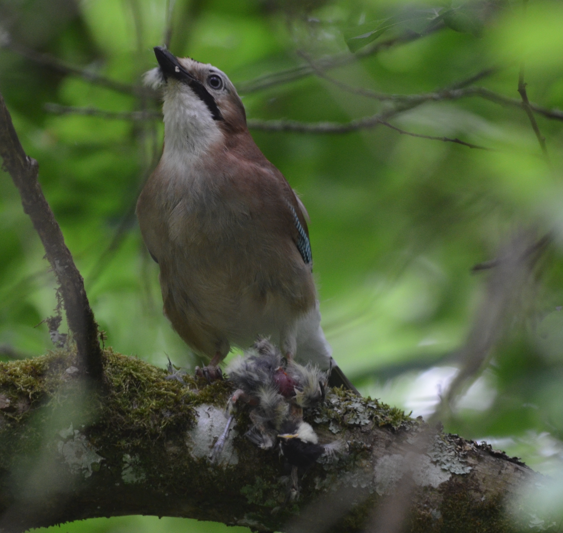
Jay with remnants of Great tit on branch
The Jay is probably the most secretive of our corvids in the United Kingdom and you don’t often see them, though you do occasionally here their cacophonous screeching, which is hard to miss really. The Jay’s diet is varied and it will eat fruits, berries, acorns, and insects, but will also eat small rodents, young birds, and eggs. Occasionally – as in this case – it will also take adult birds. With its pinkish plumage, black and white flashes on its wings, and the distinctive sky-blue and black patch on its upper wing, the Jay is arguably our most colourful corvid but seeing our first Jay in two or three years behaving in this brutal way was obviously not the best way to witness it’s reappearance. However, it is what birds – and other animals – do, and we should treat such behaviour as dispassionately as we can.
We saw two adult Grey wagtails and one fledgling all flying low along the course of the river to forage around the stones on which they alighted. It looked like the juvenile was still being fed by one or both of the adults for the most part. Much paler than its parents underneath, with barely any yellow, this youngster did seem to be learning about habitat and food sources from its parents. These are skills it will need when it becomes fully fledged, which cannot be that far off now.
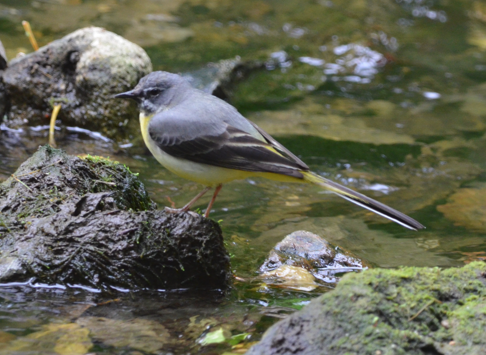
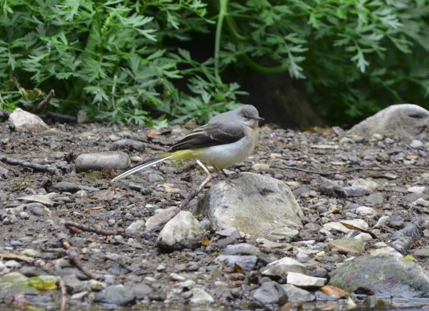
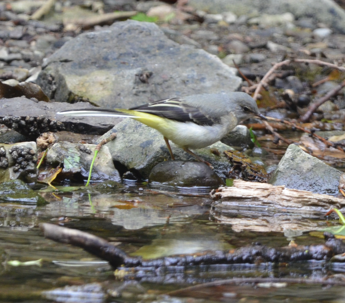
The adult Grey wagtail (top picture) is much more yellow underneath than the juvenile (middle and bottom pictures)
We caught sight of a Chaffinch as it flew from our side of the river to the trees over on the far bank. As we followed this colourful male’s progress, we almost missed the female with her more muted colouring, which enabled her to blend in with the branch on which she was perched.
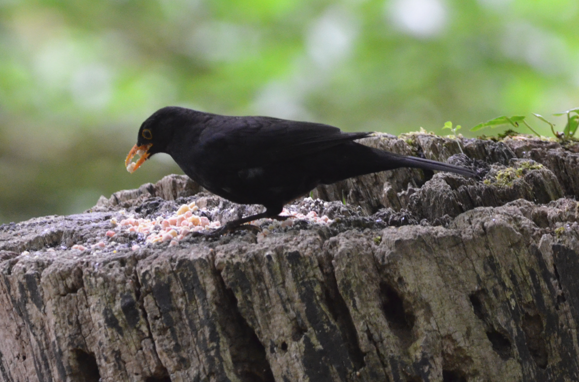
Male Blackbird
Whenever we’re here at Loggerheads Country Park, we seem to hear but rarely see Wrens. Today, we could hear one singing from the trees behind us and being answered – or competing with – one whose call was coming from across the river. As we were a little further downstream now, where the waters have receded, Stu was able to walk across the riverbed and get a photograph of this lovely little bird.
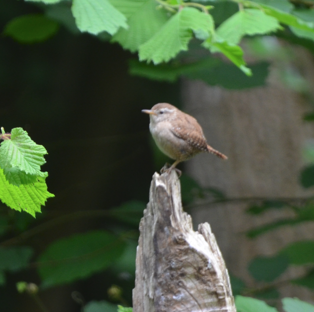
The Wren delivered a fine solo performance for us
The important stuff
Over to The Mill House café (Tŷ’r Felin) for our well-earned refreshments. Cappuccinos, unsurprisingly, with a Lemon muffin with gooey lemon curd in the middle for Col, and a Chocolate mini-egg pie (or something) for Stu. Very nice and very healthy!
[1] See Along the Leete 14th April, 2024; and The River Vanishes 27th July, 2025
