Category: nature

  • On Silent Wings

    (Thursday 2nd October, 2025)

        I was in the back yard this evening just getting a breath or two of fresh air after work and, without consciously realising, I had fallen into my usual habit of scanning the treetops and rooves of nearby houses. There was neither sight nor sound of any birds – even the familiar chacking of my numerous Jackdaw neighbours was absent. I didn’t think anything of this really: it was approaching dusk and I assumed all of our avian friends had settled in for the night.

        However, as I was looking around me, something caught my attention higher up in the sky. I saw a dozen or so birds flying quite high. They were together, but in a loose flock if you know what I mean, and they were flying silently. These birds had me puzzled to tell the truth: I hesitantly identified them as gulls, but they disappeared from view before I could be sure. I leaned back, trying to see if there were any more birds, and after a few moments I spotted another group. Again, these were quite high up and I didn’t have my binoculars, but judging by their outlines, these were definitely gulls, although I don’t know which type of gull.

        Over the next fifteen minutes or so, several more of these eerily silent gulls flew by, all seemingly heading north-west towards the Wirral side of the Dee estuary. I would never have seen them, even known that they were there, because of their uncharacteristic silence – well, gulls are often the most raucous of birds we encounter!

        I looked online later to see if this was usual behaviour for gulls flying across the evening sky and, as you might expect, there was no definitive answer, although others have evidently witnessed gulls passing in similarly quiet circumstances. One or two people suggested that the gulls were heading out to sea in the knowledge that fishing boats were in the vicinity (presumably with their hauls). This may or may not be true, but this evening’s high tide was around 20:00 hours (although the high tide time varies depending on exactly which part of Wirral the gulls were heading). Nevertheless, the gulls flew past me about an hour or so beforehand, so it’s possible that the intention was to be onshore as the tide began to retreat, exposing the crustaceans and molluscs that they favour. I can’t help thinking that this theory is a bit limited though, given that most gull species will eat anything!

    No photographs for this post I’m afraid – just an observation. (The gulls were too far away for my humble camera-phone anyway). 1

    1. I witnessed this phenomenon again on the following evening although the gulls were flying lower this time. It was windier than the previous night due to Storm Amy (although Scotland bore the brunt of the winds) and I thought possibly the storm might have had a bearing on the gulls’ behaviour. However, I’m inclined to think that it’s more the timing of the tides. I’m writing this three days later (Monday 6th October) and I haven’t seen any similar activity in the last three evenings. Anyway, something to look out for – well, if you’re me at least!
      ↩︎
  • Rain stops play

    (Sunday 7th September, 2025)

        We were at Loggerheads Country Park this morning and, although it was overcast, it was a reasonably mild 18°C, with a light south-westerly wind which was barely perceptible in the shelter of the woods. As we crossed the little bridge to the Leete path, we glimpsed a Dipper scooting upstream. We’ve seen them before along this stretch, but this was to be our only sighting today.[1]

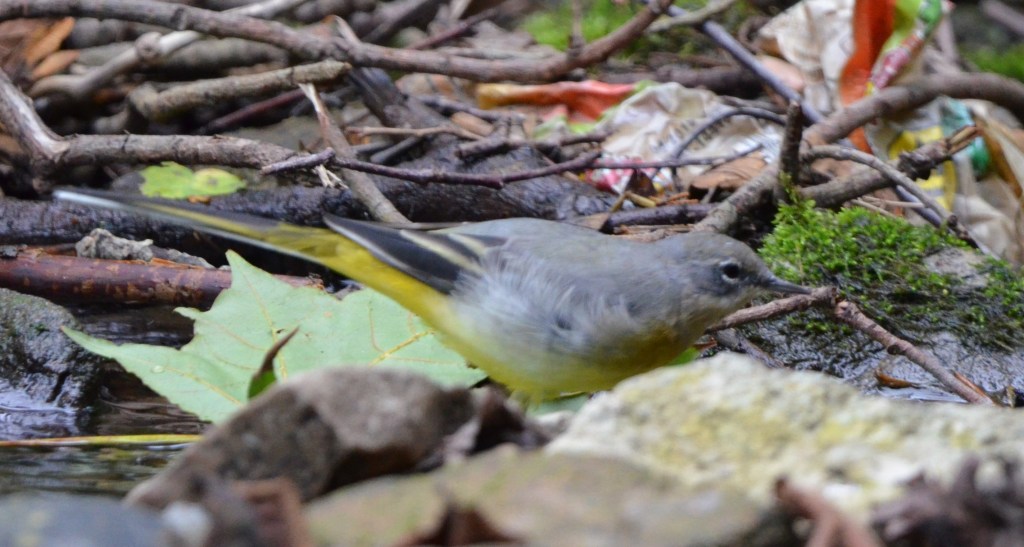
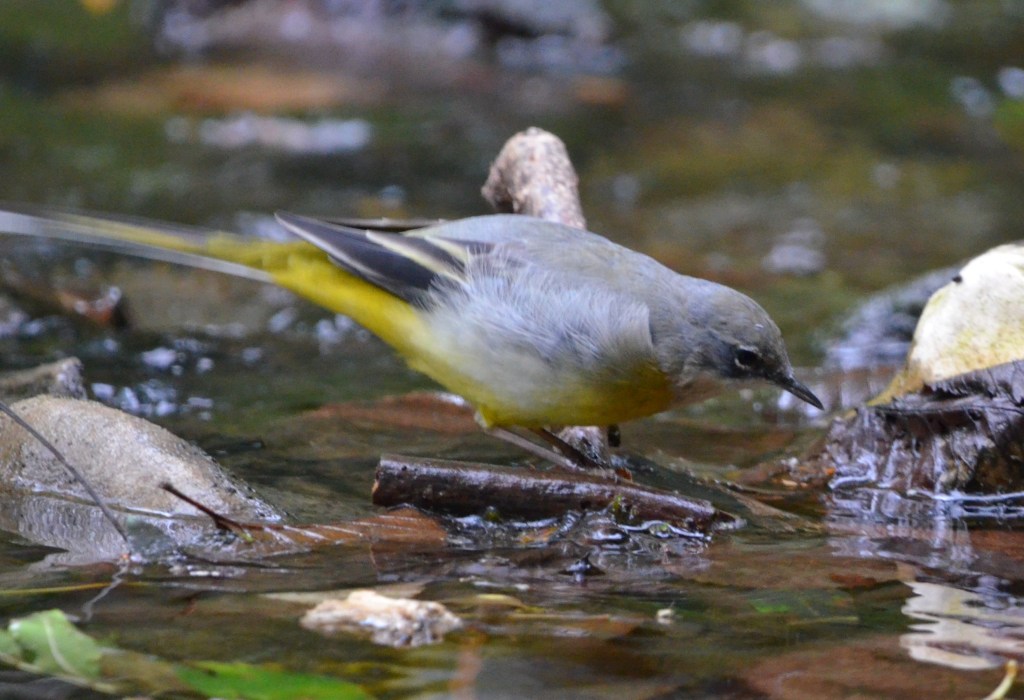
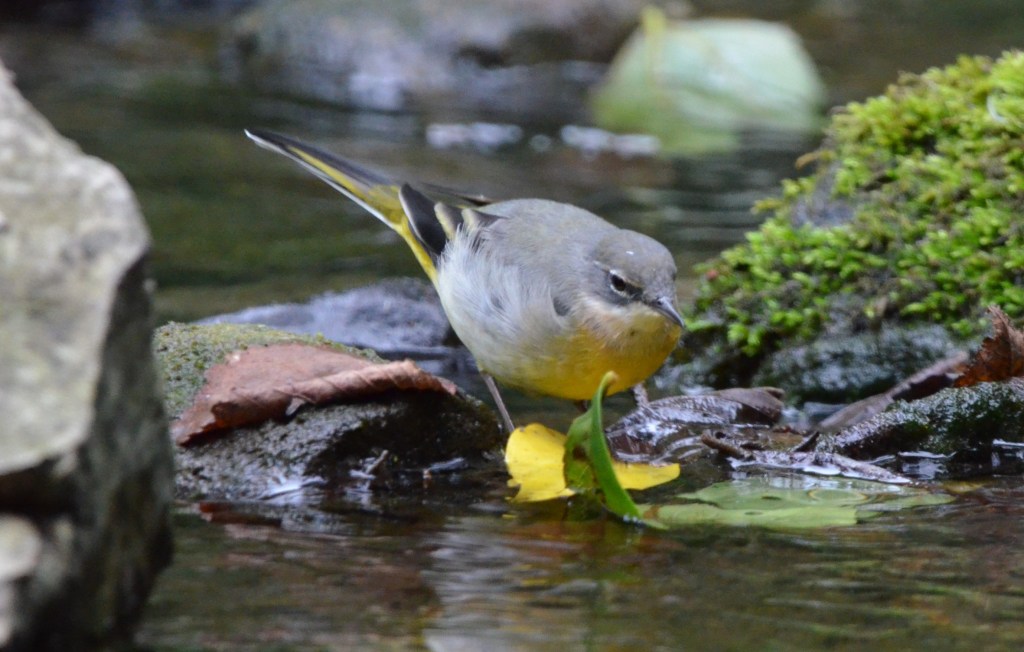
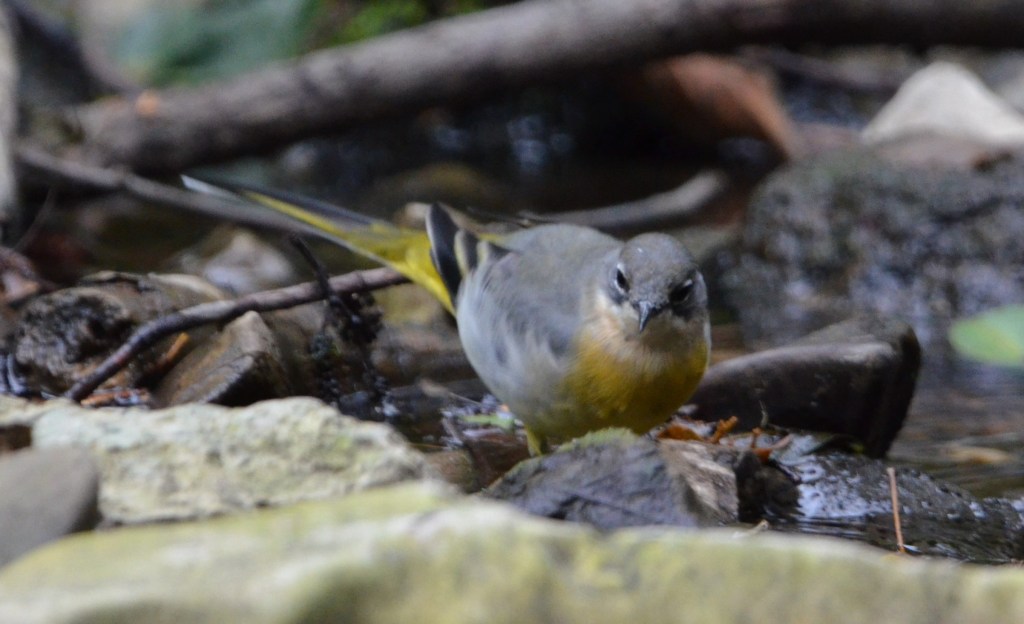
        We followed the Leete a short way, while scanning the riverside, each of us hoping to catch another sighting of the Dipper. I detected a little movement as I trailed my binoculars slowly over the landscape – or riverscape to be more accurate. Looking again, I saw that the movement was the long, see-sawing tail belonging to a Grey wagtail, which was perched on a rock as it scanned the water for food. This one was either a female or a juvenile as it lacked the distinctive black bib that males display during the summer (and I’m classing this as summer, or summer’s end, despite it being meteorological autumn). The grey, white, black, and lemony yellow form a lovely combination as you can see.

    Grey wagtail facing
    Grey wagtail side view

        Seen close-up, the Grey wagtail does strike you as being more colourful than its dullish-sounding name suggests, particularly in its underside feathers, and people often mistake it for the Yellow wagtail: the ‘Grey’ of its name refers to its grey back. The Yellow wagtail has an olive-green back and is much more yellow overall. Habitat is often a giveaway when trying to establish species, and Grey wagtails and Yellow wagtails differ from each other quite markedly in this respect. Grey wagtails are usually to be found near running water, where they can hunt for food, whereas Yellow wagtails prefer open fields and meadows, especially favouring ground that’s been disturbed by livestock, such as cattle or sheep, as this means that the birds can easily graze on the worms and grubs that are revealed as a result.

    Grey wagtail side view 2
    Grey wagtail and leaves

        We have seen Grey wagtails along the River Alyn here many times over the years and we’re fairly confident that they build their nests in the nearby cliffs that overlook the river. We were also lucky enough to see a family of Yellow wagtails quite recently in a cow field, happily scrabbling around the feet of their much larger bovine companions.[2]

    There was a little more water – or slightly less exposed river-bed – than the last time we were here. The river still disappears, but now just that little bit further downstream. However, there is still evidently enough food – aquatic and aerial – to satisfy the Dippers and Grey wagtails that share this short stretch of the Alyn. As the title of today’s post suggests we beat a hasty retreat after only an hour-and-a-half or so. The rain came down heavily and, within seconds, the ground became saturated and we were a little bit soggy ourselves.

    The important stuff

    Sadly, Caffi Florence closed its doors recently, which is such a shame. The staff were wonderful and obviously we have many happy memories. Today, though, we had to go elsewhere for our coffee and cakes and we decided on Daleside Garden Centre in Hawarden (yes, I know, it’s officially ‘Klondyke Strikes’, but we all still refer to it as ‘Daleside’). Anyway, the cappuccinos were accompanied by an Eton Mess slice (Stu) and a Raspberry Meringue (Col). Very nice!


    [1] Morning Dippers, Sunday 24th August, 2025

    [2] Bittersweet Memories, Sunday 3rd August, 2025

  • Birds, Butterflies and Belugas

    (Thursday 21st August, 2025)

        Over to the RSPB wetlands at Burton on the Wirral peninsula today with my mother, my youngest brother, Michael, and his eldest daughter, Sophie. None of them had visited here before. The sun came out from time to time, but it was otherwise overcast. When we arrived, we were told that a Bittern had been seen at the reedbed: it showed itself twice during the time that we were there, but not in our presence I’m afraid!

        A Greenfinch and a Great tit were taking it in turns to visit the feeder, just beyond the visitor centre. While absorbed in this sight, we noticed movement in the undergrowth, and after a few moments we saw several rats shuffling along stealthily: they looked very well-fed and were obviously regular visitors to the ground beneath the feeder, capitalising on all that the birds habitually spilled.

    Mallard on tree trunk

        Above: Mallard on tree trunk (Photo: Sophie)

    We meandered around the mere, noting a Mallard squatting on the upper part of a tree-trunk that was half-in, half-out of the water, and a pair of Moorhens that were investigating the edge of the shore for food. While we were looking over at some Canada geese that were swimming at the northern part of the mere, there was a commotion in the water nearby: a Cormorant surfaced, took a few breaths, and then dived in search of fish again. A chance now-you-see-me-now-you-don’t sighting which we were all happy to have witnessed.

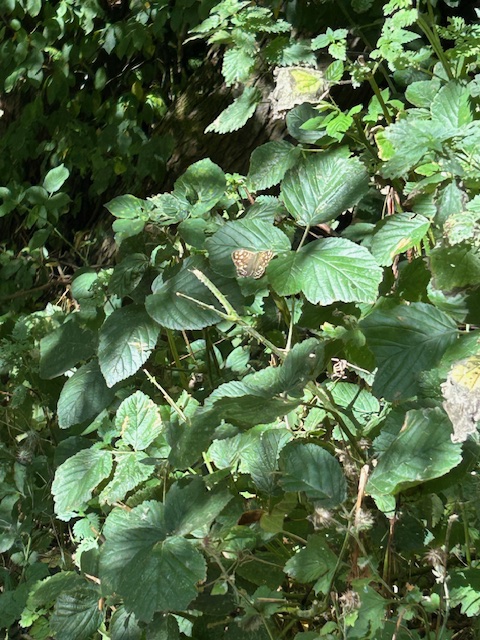
    Left: Comma – note the distinct white mark that gives the butterfly its name, and Right: Speckled wood (Photos: Sophie)

    There were plenty of butterflies today, including Small whites, Green-veined whites, and lots and lots of Speckled woods. In fact, as my niece, Sophie, was focussing her camera-phone on one Speckled wood that was stretching out its wings atop a leaf, a pair of them were spinning around each other as they passed. Sophie also managed to photograph a Comma, its wings upright, and another butterfly which we suspect is a Dark-green fritillary, though we can’t be sure. This is guesswork really, as camera-phones are limited in the photographic detail that they capture, so the resultant picture isn’t exactly pristine. However, given the area that we were in – ancient oaks predominantly – and the fact that the commonest fritillary in the United Kingdom is the Dark-green, we’ll plump for that. (Please let us know if you have other thoughts).

    Fritillary

        Above: Dark green fritillary? (Photo: Sophie)

    Regular readers will remember that on Sunday just gone (17th August), we reported lots of small flocks of Canada geese orbiting the marshes nearby. Judging by the amount of Canada geese at the wetlands today, they had all ended up here! They were by far the most numerous bird species to be seen from the main Reception area and also from the Bunker hide, and now looking from the Marsh Covert hide, it seemed that all we could see was Canada geese. However, as if to dispel this idea, Sophie suddenly drew our attention to a Common buzzard that she’d spotted circling to the south, and which rapidly rose in the air on the thermals. We all watched it through the windows, noting its large size even at a distance.

        A number of orange-red dragonflies shadowed us along the paths between the Marsh Covert and Border hides and seemed, at times, to be leading us onwards. These are Common darters, and we even saw one pair mating while they were in flight. A Marsh harrier crossed close overhead and, while we didn’t manage to photograph it, we did have a clear view of its underwing, which was the distinctive grey, fringed with black outer feathers, of the male.

        From the Border hide we could see lots of Greylag geese, Lapwings, and Black-tailed godwits, and we also observed a couple of Redshanks on the far bank and some Teal on the isle nearby, just visible amongst another group of Greylags. On the return journey, just as we emerged from the small copse, a Kestrel flew across our path.

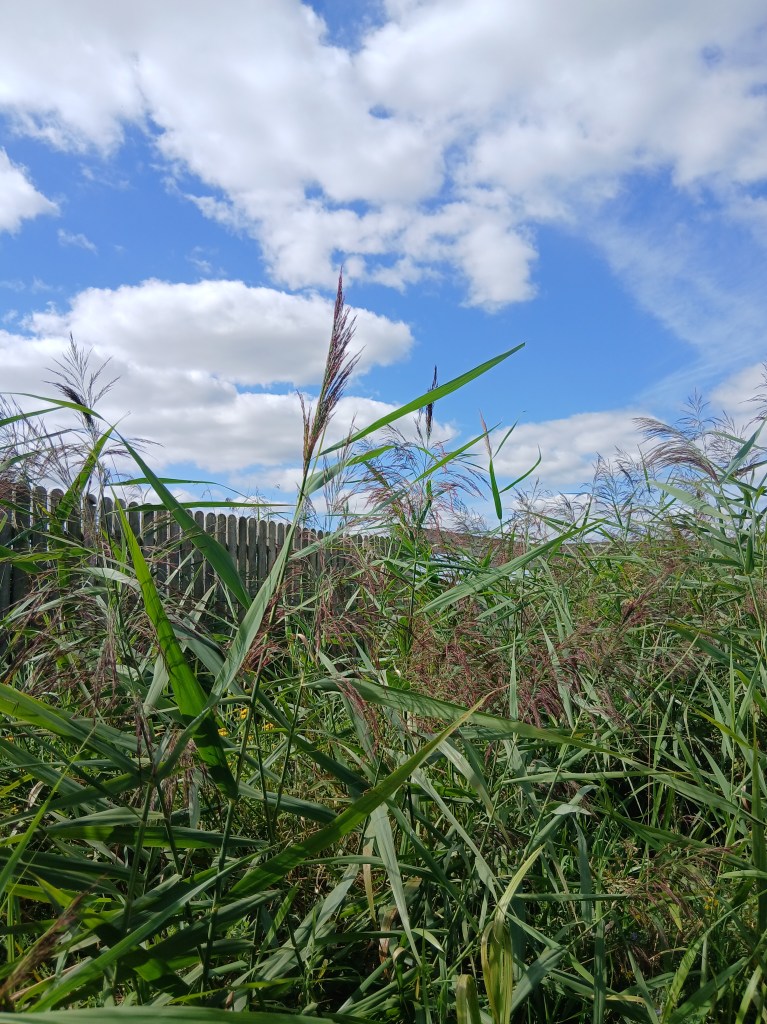
    Common reed

       Above: Common reed

    Sophie and I detoured to the reedbed to see if the Bittern was there, but sadly not. As I mentioned at the very beginning of this article, the Bittern was only eluding us – it seems that everybody else saw it that day! A lucky few also saw a Kingfisher and a Hobby. Maybe another time, but I do know that Michael, Sophie and my mother were thrilled to have seen so much during their visit. As we emerged from the reedbed viewing spot, my mother, who was waiting with Michael, said: ‘Did you see the big bird, then?’ I thought we’d missed a Heron or an Egret or another large bird, but she meant the Airbus Beluga which had just flown past. Very amusing!

    The important stuff

    All four of us had cappuccinos, accompanied by Blueberry muffins (Sophie, Michael, and my mother) and a very tasty vegetarian pastie (Col). Awesome!

  • Spotted in the garden

    (Wednesday 23rd July, 2025)

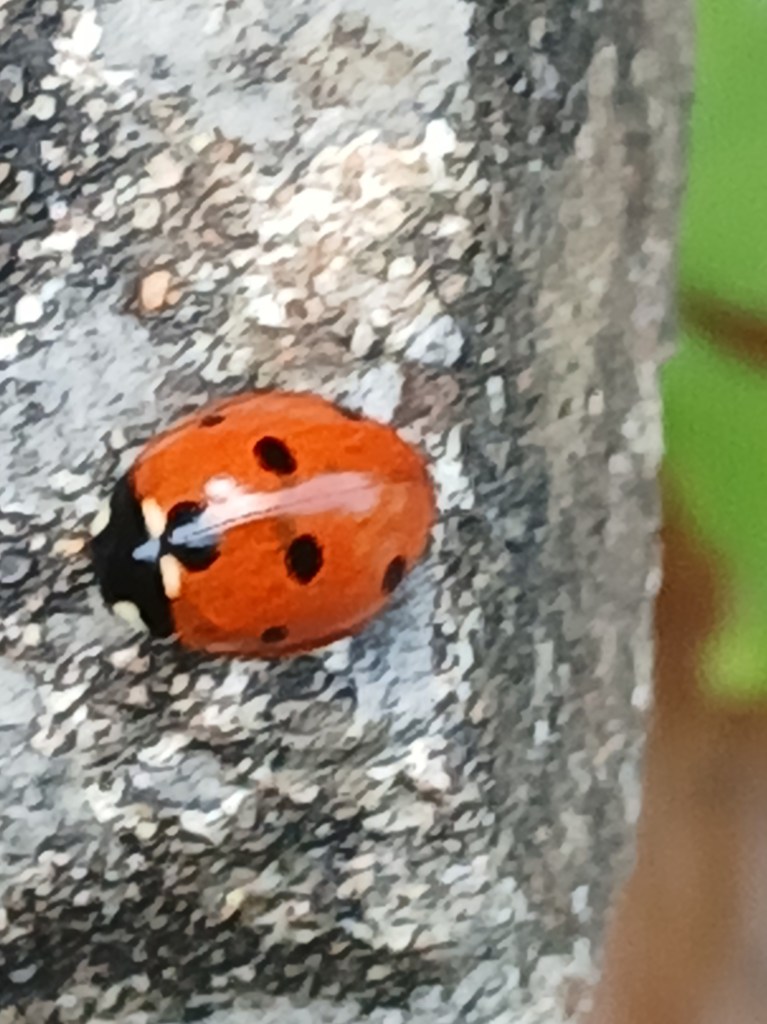
    Seven-spotted ladybird

    Down to the garden for my customary post-work respite, and I found a Seven-spotted ladybird reposing on one of the coping stones of the lower wall. There were several Small white butterflies and a Large white at the bottom of the garden. There were a couple of Holly blues too: at first, I thought that it may have been the same one travelling the length and height of the ivy,

    but I was eventually disabused of this notion when I witnessed two of them spinning around each other, though I’m not sure whether they were bickering or flirting!

        As I watched these spinning butterflies, my line of vision was interrupted by what I’m fairly certain was a Meadow pipit scampering across the top of the two steps that descend to the lawn. Its markings were darker than the whiteish cream of the textbooks, and overall it was brownish although obviously mottled below. The tail was distinctive though the legs were more of a red hue than a pink. I’m sure it wasn’t a Tree pipit, although pipits are notoriously difficult to tell apart. (Well, they are for me).

        Later I watched our resident Goldfinch alight on the very top of a huge Norwegian spruce in a neighbouring garden, which towers above all of the trees nearby. Uncharacteristically for this Goldfinch, he remained silent but watchful until he suddenly launched himself from his perch and dived towards the ground, but his descent was quickly screened by the border foliage, so I didn’t see the result of this kamikaze leap.[1]


    [1] I’m pleased to say that Mr. Goldfinch re-appeared the next evening and sang from his customary perch at the end of the television aerial. He practised his scales for a while and then flew off – no mad diving this time!

  • Seven spots followed by a Comma

    (Thursday 10th July, 2025)

        In the garden for a brief break from work (meetings, meetings…) and it was incredible what I saw in ten minutes: I must have timed it right. First was a Holly blue: these small butterflies usually fly at head height, but this one flew over twice that height again. As I followed its haphazard trajectory, I noticed a red and black ladybird apparently munching away on an ivy leaf. Drawing closer, I saw it was a Seven-spot ladybird.


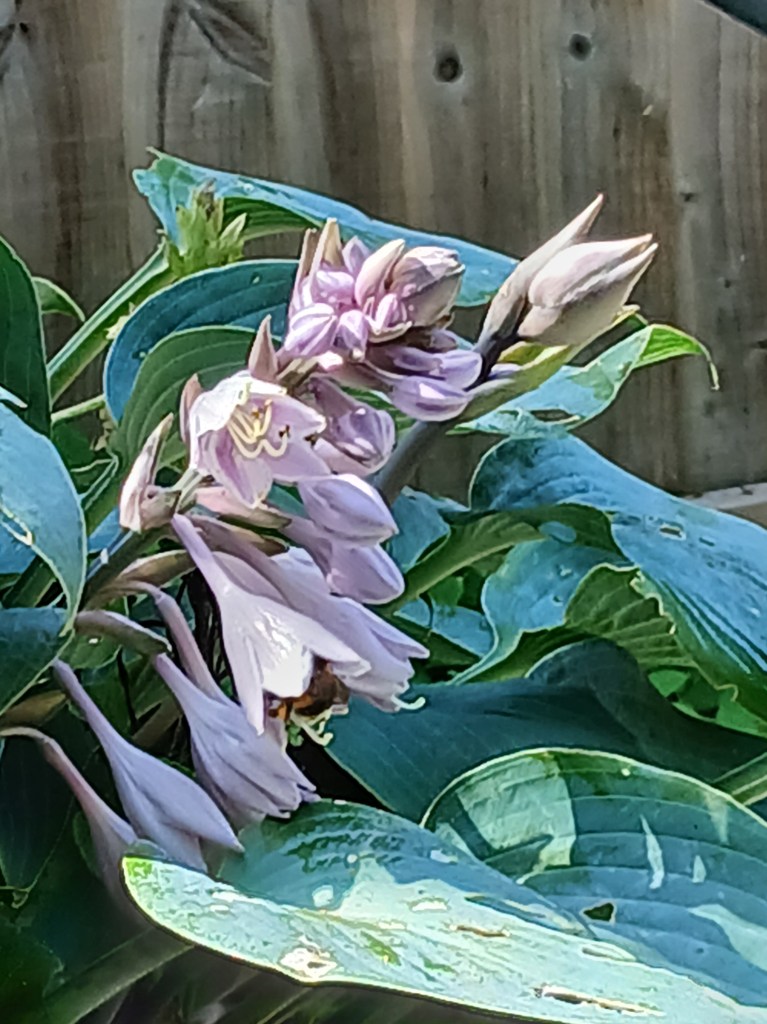
    I watched a Bumblebee (you can just see its bottom) and a much smaller bee extracting nectar from my Hosta plants which have recently bloomed a lovely pale purple. While I was doing so, something caught my vision and I turned to the hedge again. It was a Red admiral which very obligingly alighted on a leaf and spread out its wings to display its lovely markings.

        Two white butterflies then attracted my attention as they flew down the garden, spinning round each other. I thought they might be Large whites but I wasn’t sure, so I picked up my binoculars to get a closer look. Well, it’s difficult enough to follow birds in flight – particularly ‘flitters’ such as Swallows, Martins and Swifts – but trying to keep up with butterflies is a lot harder. Never mind this pair of butterflies (Large whites I can confirm), it was my head that was spinning. However, as I gave up chasing them, I spotted another Red admiral which was chilling out on the Buddleia at the far end of the garden.

        Once again, I reacted to movement and was amazed to see a Comma which landed on a bramble leaf nearby. This was only the second Comma I’ve ever seen, so I was pretty chuffed. On the way back in to the ‘office’, I saw another Holly blue flying high again, unless it was the same one as before. My short but well-earned break turned out to be a butterfly marvel!

  • Peacocks and Painted Ladies

    (Wednesday 9th July, 2025)

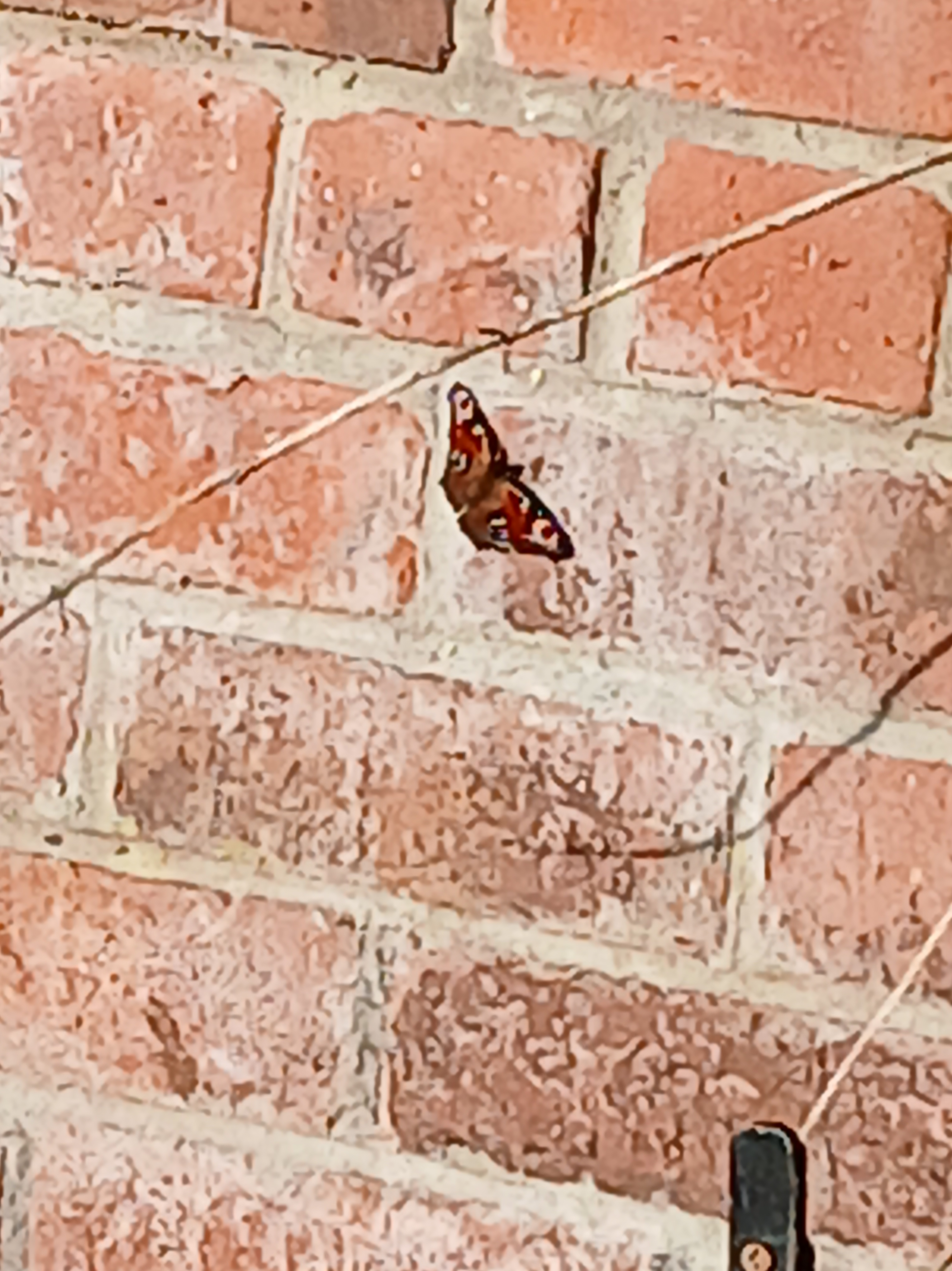
        It was still sunny here this evening so I went outside into the back yard to enjoy the warmth for a few moments. A Peacock butterfly evidently had the same desire, opening its wings as soon as it landed on the wall. When I say ‘on’ I mean it was on the surface of the wall rather than on the coping stones at the top, which you might expect. The Peacock was just hanging there vertically!

    Peacock butterfly on wall

    The wall is an old, rather wonky wall that reaches from the back of the house as far as the gate to the garden. It’s a west-facing wall and catches the sun (when it’s sunny) in the afternoons and evenings. I have several plants along it for that reason. Anyway, I managed to take a photograph, although it was with my phone’s camera, and not the best picture you will ever see.

        Only moments later, a Painted lady landed, but this time on the ground. I suppose it didn’t want to compete with the Peacock’s earlier acrobatics, but the Painted lady also spread out its wings obligingly for me. I was a bit slow off the mark this time however, so didn’t manage a photo. Mind you, that may be no bad thing, judging by the standard of the Peacock photograph!

        I was thrilled to see two different species of butterflies displaying their wings in quick succession, especially as they both just appeared in the back yard. It just shows you that sometimes you really don’t have to go far to see nature’s wonders.

  • Butterfly blues

     (Thursday 3rd July, 2025)

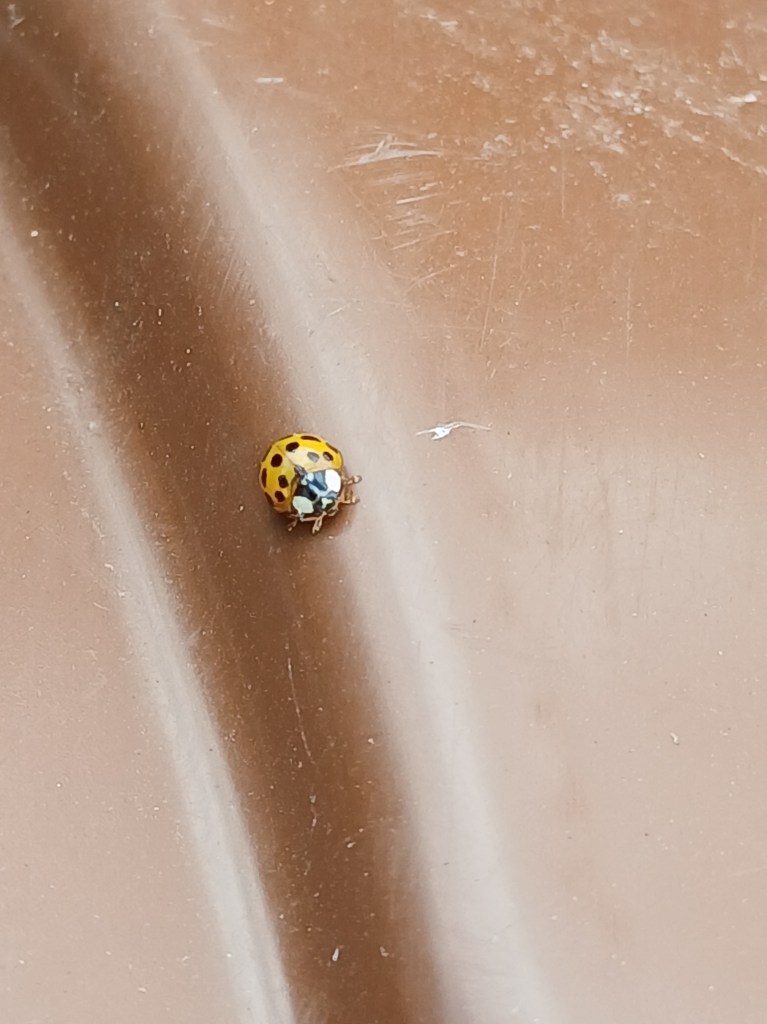
    Harlequin ladybird

    Down to the garden after work – I noticed a Harlequin ladybird on the brown bin lid as I went by. This one was a pale yellow with black spots, though what it was doing on the bin lid I have no idea. Jackdaws and Crows predominated today and both corvids were very voluble in their own raucous ways.

    My resident Robin appeared,

        hopping along the ridge of the fence to see what was to be seen, and three Goldfinch seemed to be tree-hopping, twittering as they did so.

        I watched excitedly as a large, yellow butterfly fluttered around the Buddleia at the far end of the garden, and then flew towards me before disappearing over the hedge. This was the first Brimstone I had seen for a couple of years. In fact, this was my first ever sighting of a male Brimstone, having only ever seen one Brimstone previously, which was the lime-green female. (The female was at the entrance to the path that edges the golf club, which is about half a mile away, although further away in time) I am so pleased to have seen one again. I’m not very knowledgeable about butterflies, but I believe the Brimstone is very scarce here in North Wales.

        It was certainly a day for butterflies: besides the Brimstone, there were a few solo, Green-veined whites, and a pair of Large whites twisting around each other as they flew over me to the other side of the hedge. And there was a Holly blue climbing up and down the ivy of the hedge, not unlike a bee in its rather haphazard flight. And I’m sure I saw a male Common blue. Certainly, it was a lot brighter blue than the  mauve-blue shade I associate with the Holly blue, but I was puzzled as this Common blue was flying up and along the high hedge – apparently it’s generally the Holly blue that flies high while other blue butterflies fly low. Unfortunately, I didn’t manage to photograph it so it will have to remain a ‘maybe’.

  • Aerial view

    (Monday 16th June, 2025)

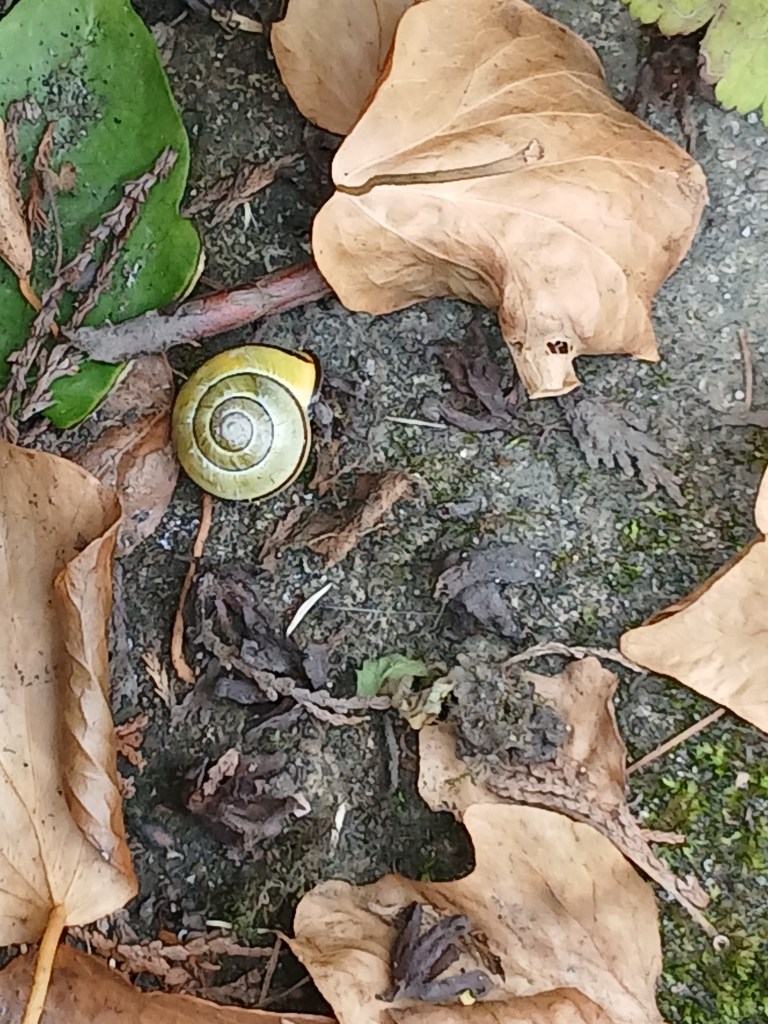
        A couple of female Blackbirds put in separate appearances while I was in the garden today: presumably they were gathering food for their respective broods. My eyes were drawn to a snail shell at the base of some past-flowering cowslips. It was bright yellow with dark brown – almost black – concentric bands. I looked it up later and this is the Brown-lipped snail (also known as the Brown-lipped banded snail). The name refers to the band of colour around the shell’s opening.  

    " "

    The shell colour can vary from light yellow to dark brown, although oranges and pinks can occur (I’m beginning to sound like a Weather Forecaster, covering all eventualities!), and there can be from none to five bands (or stripes). You won’t be surprised to learn that the reasons for the variations in shell colour and banding are not known, though it is suspected that camouflage might play a part.

    The Brown-lipped snail is common throughout most of the United Kingdom and can be seen in various habitats, including woodland, hedgerows, and gardens, so the variations may be adaptations to their surroundings, although nobody can say for sure.

        Behind me, I heard a lovely tinkling sound. I looked up and, sure enough, there was the usual Goldfinch singing from his perch at the end of next door’s television aerial. This particular Goldfinch has been taking a turn for a few days now: one day he continued to sing while a Jackdaw perched on the chimney pot a little lower. In fact, the Jackdaw flew off, leaving behind the Goldfinch!

        I left this colourful chorister singing and turned back to the garden. Another Goldfinch sang from the top branches of the willow in my neighbour’s garden and then flew across mine, landing over the far side of the hedge, where it resumed its song. No wonder they’re called a ‘charm’ of Goldfinches!  

  • Unflappable Buzzard

    (Thursday 19th June, 2025)

        In the garden during today’s promised heatwave (the temperature reached 29° in Hawarden). I could hear two Wood pigeons calling to each other and some Jackdaws doing the same. From time to time, I heard what I first thought was a single long ‘coo’, which came across as a long purr of contentment! However, I soon realised that the long purring ‘coo’ was preceded by a shorter sound, and this was probably the sound of a nesting Wood pigeon.

        Interspersed with it usual melodious song, a Blackbird issued a series of clicks – tchk – tchk – tchk … and these were answered by its mate as it passed by over the garden fence. I’m sure that there’s a nest in the hedge, although I’m not quite sure what the clicking noises mean.

        My ponderings were interrupted by several piercing cries from above. I looked up and saw that the racket was coming from three Herring gulls that had become alarmed by the appearance of a Common buzzard. Despite the ‘mobbing’ of the gulls, the buzzard continued unperturbed in its majestic ascent on the thermals. I noted that none of the gulls came too close to the predator though: I’ve watched even single crows chasing buzzards with more boldness!

        Things settled down as the buzzard slowly gyrated further through the azure sky. Two of the Herring gulls seemed to take it in turns to guard a chimney pot on one of the nearby houses, so they may well be nesting and perhaps this explains the earlier commotion. Mind you, they are noisy birds anyway!